
It’s a blanket statement, but it’s generally safe to say that there’s a lot going on in a Queen song.
What often starts as something simple quickly becomes layered. Take something as simple as voices— one voice becomes three, then ten, and then what sounds like an entire wall of people singing. A piano can start out quietly, then the song takes a hard left turn somehow and suddenly the entire track is rich and layered with guitars piling in and the mood has changed completely. But when Queen does it, it makes perfect sense, and that’s part of what makes their music so much fun to listen to.
Queen never stayed particularly close to the boundaries of rock music. They borrowed from opera, theatre, and classical music, mixed those ideas with rock, and then did some uniquely Queen things with all of it.
Freddie Mercury’s documented love of opera and theatre is part of that story, of course, but you can hear these influences without knowing anything about his biography. Listen to how the music builds and pulls back. Listen to how many different voices or instruments can be doing their own thing at the same time but still work together.
We might be a little biased, but one of our favorite parts is when it sounds like there’s an orchestra in the room (even when there isn’t).
Those huge layers might be voices recorded over and over again, or layered guitar parts that end up sounding like a whole group of instruments. And sometimes, that sense of scale comes from the way that the song itself is built.
Once you start noticing these things, there’s a natural question: When we say that Queen has a classical sound, what are we really hearing?
So, What Makes Music Sound “Classical,” Anyway?
This is where the word “classical” can get a little messy, because it can mean a few different things depending on who’s using it.
When we hear classical music influence in a Queen song, we’re not necessarily talking about violins showing up in the middle of a rock track. In this case, we’re talking about how the song is put together, the layers of voices, and the way that different musical parts interact with each other. But it’s also about the drama with the big changes in mood, volume, and intensity.
Queen guitarist Brian May has talked about deliberately using his guitar as if it were an orchestral instrument. When Queen recorded Queen II, the band finally had enough studio time to experiment with layering sounds in ways that they hadn’t been able to do before. May described this as the beginning of “guitar orchestrations,” building multiple guitar parts together to create different textures behind the main melody.
“That was the fulfillment of an ambition for me, to get started on that road of using the guitar as a kind of orchestral instrument.”
Brian May, Queen guitarist, on recording Queen II
And Queen didn’t stop with the guitars. Vocals could be layered again and again allowing just a few voices to become something significantly larger. The studio gave the band another set of tools to play with, and they used them extensively.
Opera adds another wrinkle. Because calling a piece of music “operatic” doesn’t necessarily mean we’re talking about an opera.
One of the things that separates opera from music written for orchestra and chorus is drama. Opera uses music to tell a story, create characters, set a scene, and move an audience through whatever is happening onstage.
With Queen, we might be hearing something in the scale of the music, the vocal arrangements, the theatricality, or the way the song moves from one section to another with dramatic effect. A song can feel like a scene unfolding, with different voices seeming to take on different roles, changing the mood, and the music itself helping to create the drama.
There isn’t one ingredient we can point to and say, there it is. We’re listening for several different ideas, and Queen had a habit of mixing them together.
Which brings us to the song where they famously pushed that idea very, very far: Bohemian Rhapsody.
How “Bohemian Rhapsody” Blends Opera and Rock
If there’s one Queen song that seems determined to go everywhere in six minutes, it’s Bohemian Rhapsody.
It starts simply with those now-famous voices, moves into a piano ballad, and then things start getting, well, a little weird. There’s a guitar solo, then an opera, and then suddenly, we’re in the middle of a hard rock song. And after all of that, it pulls all the way back again.
Somehow, it works.
These were never just a collection of ideas the band stumbled onto while recording. Brian May has said that Freddie Mercury came in with different pieces of the song already in mind, and knew how he wanted them to fit together. May described Mercury as having an “amazing kind of blueprint in his head” for how the finished song should sound.
That included what Queen themselves called the “opera section.”
And this is where the distinction we made earlier becomes useful. Bohemian Rhapsody isn’t an opera, but for part of the song Queen very deliberately borrowed from the sound and drama of opera. Voices answer one another, there are enormous stacked harmonies, sudden changes in intensity. Even some of the names pull us toward the theatre: Figaro is a character who appears in famous operas by both Mozart and Rossini, and names like Scaramouche come from the Italian theatrical tradition of commedia dell’arte.
What sounds like a chorus was created by just three members of the band: Freddie Mercury, Brian May, and drummer Roger Taylor. They recorded their vocal parts again and again, layering harmonies until those three voices became something much larger. Producer Roy Thomas Baker recalled that they originally thought the opera section would contain only a couple of “Galileos.” They kept adding to it, and the section eventually took about three weeks to record. That’s significant considering the band usually spent about 3 weeks in the studio for a complete album.
And then Queen does something fun with the excess: they follow it with a completely different sound— a wall of voices gives way to Brian May’s guitar and a much heavier rock section before the song eventually settles back down for its quiet ending.
The Classical and Theatrical Influences in Other Queen Songs
Bohemian Rhapsody might be the obvious example, but Queen didn’t save all of their experimentation for one song.
And it didn’t always sound the same, either.
Take Love of My Life. Compared with the sheer scale of Bohemian Rhapsody, it can feel almost intimate. But when Freddie Mercury talked about the song in 1975, he specifically described it as a place where his classical influence came through. The studio recording centers on Mercury’s piano and even includes Brian May playing an orchestral harp.
Apparently, that was about as straightforward as you might imagine. May later recalled working his way through the harp part chord by chord and finding that keeping the instrument in tune was one of the biggest challenges. The result gives us a very different example of what classical influence can sound like in Queen’s music.
Then there’s The Millionaire Waltz, which takes us somewhere completely different. The waltz in the title is very much there, but Queen, they don’t exactly leave it alone. The song moves between contrasting sections while guitars become part of the arrangement in increasingly elaborate ways. Mercury was particularly proud of what May did on the recording, saying he had taken his “guitar orchestration to its limits.”
May later described building one passage from multiple guitar parts spread across several octaves, eventually creating somewhere around 18 to 20 guitar tracks.
So, if you listen to The Millionaire Waltz and find yourself wondering how one electric guitar is making all of that happen, the answer is pretty simple: it isn’t one electric guitar.
We’ll come back to that idea, because Queen’s habit of turning the recording studio into another musical tool deserves a section of its own.
But there’s another song worth stopping at first, because it helps us avoid lumping everything Queen borrowed into one big “classical” bucket.
Somebody to Love is built around a different influence entirely: gospel.
Mercury spoke about his admiration for Aretha Franklin and the gospel sound of her earlier records when discussing the song. Queen then used a trick that should sound familiar by now. Mercury, May, and Roger Taylor recorded layers of their own voices to create the impression of a much larger choir. This time, though, they were reaching for a different sound.
Brian May put the difference rather neatly:
“This time we were being a Gospel choir, instead of being an English choir.”
Brian May, on recording Somebody to Love
Classical music was part of Queen’s musical vocabulary, but was never the whole vocabulary. They borrowed from classical music in one song, built around a waltz in another, and drew from gospel in other places, and still, the sound of it all is unmistakably Queen.
How Queen Used the Studio Like an Orchestra
By this point, you’ve probably noticed a pattern: Queen likes using layers.
But when we talk about layering guitars or vocals, we don’t necessarily mean recording the exact same thing over and over again to make it louder. Often, these were different musical parts that were designed to work together, kind of like individual voices in a larger group.
Brian May described wanting to “build up textures behind the main melody lines,” something Queen finally had enough studio time to really explore while recording Queen II. Different guitar parts could occupy different ranges, play different lines, or harmonize with one another until May’s guitar started doing the work of several instruments at once.
You can hear a particularly fun example in Killer Queen. Instead of listening for a guitar solo, try listening for the guitars. May described that section as three guitar voices, each doing something a little different while working together.
Today, recording software gives musicians an enormous number of tracks to work with. In the 1970s, Queen didn’t have that luxury. Their early recordings were made using tape machines with a fixed number of available tracks. Once those tracks were full, but the band still wanted to add more, they had to make more room.
One way to do that was something called “bouncing.” In very simple terms, several finished tracks could be combined onto one, freeing up space for the band to keep recording. Then they could fill those newly available tracks, combine things again, and keep building. Brian May has described using this process for both guitar and vocal arrangements.
If that sounds like a lot of work, it was.
Remember all those voices we just talked about in Bohemian Rhapsody? Producer Roy Thomas Baker explained that the band would record layers of harmonies, combine them to make room, record more, and continue the process again and again. Some of the recording was copied through multiple generations as the arrangement grew.
Baker summed it up perfectly:
“The making of ‘Bohemian Rhapsody’ was basically one continuous track bounce!”
Roy Thomas Baker, Queen producer
And because this was physical tape, “editing” could mean exactly that. Baker recalled physically cutting the tape and adding more as Freddie Mercury continued expanding the opera section.
All of that experimenting created another funny problem: people didn’t always believe the sounds they were hearing came from guitars and voices.
Queen’s early albums famously included variations of the message “No Synthesizers!” Brian May later explained that some listeners assumed the unusual sounds created by the band’s layered guitars and vocals had to be coming from synthesizers. Queen wanted to make it clear that they weren’t.
Why Queen’s Music Works So Well with a Live Orchestra
After everything we’ve talked about so far, putting Queen and a live orchestra in the same room starts to make a lot of sense.
Queen’s recordings are already full of layers. There are individual guitar lines working together, vocals stacked into choirs, dramatic shifts from quiet to huge, and different sounds coming in and out of focus. An orchestra gives an arranger an entirely new collection of musical voices to work with.
But there’s an important distinction here: adding an orchestra doesn’t mean simply putting strings behind a rock band and calling it symphonic.
Brian May has talked about this himself. When discussing orchestral arrangements of Queen’s music, he noted that simply combining an orchestra with a rhythm section doesn’t always work. What he praised instead were arrangements that responded creatively to the original music.
A guitar line can be shared among different instruments. Strings can carry sustained lines or add another layer underneath the melody. Brass can bring weight to a big moment. Percussion can make an already dramatic shift feel even bigger. And those enormous vocal sections Queen created by recording the same three singers over and over again? A live chorus can put that wall of voices right there onstage.
The possibilities get much bigger, but the goal is still to serve the song.
Queen themselves understood that a live performance didn’t have to reproduce a recording exactly. May has explained that when the band took their music onstage, they adapted it for live performance rather than trying to recreate every studio texture note for note.
Love of My Life is a great example. The studio recording we talked about earlier is elaborate, with piano, harp, layered vocals, and guitar. Live, Queen stripped it down dramatically, with May on 12-string acoustic guitar and Mercury leading audiences that eventually began singing huge portions of the song themselves.
It became something different without becoming any less Queen.
That’s really the interesting part of hearing this music with an orchestra. You already know the songs, but now there are dozens of musicians available to take on all of those layers, colors, and musical ideas Queen packed into the originals.
You’re still hearing Queen. You just get to hear what happens when that music is given a lot more voices.
What to Listen for the Next Time You Hear Queen
So, what do you do with all of this the next time a Queen song comes on?
Mostly, just listen. But this time, pick something and follow it.
Listen for the layers. Choose one part of the song and stick with it for a while. Follow the guitar, the piano, the voices, or the bass and see what it’s doing while everything else is happening around it. Then listen again and pick something different.
Notice when one voice becomes many. We’ve seen how often Queen used just a few singers to create something much bigger. Listen for those moments when a single voice suddenly seems to turn into an entire crowd.
Pay attention to the handoffs. What has your attention right now, and what takes over next? Maybe it’s Freddie Mercury’s voice, then the piano, then Brian May’s guitar. In a song like Bohemian Rhapsody, following those handoffs can completely change the way you hear a song you’ve probably heard hundreds of times.
Notice how big the music feels. Queen can move from something that feels like one person alone at a piano to a wall of sound, sometimes remarkably quickly. Listen for those moments when the music grows, pulls back, and grows again.
And finally, listen for the sounds that make you wonder, “Wait, what is that?” With all of the guitar layering, vocal overdubbing, and studio experimentation we’ve talked about, the answer isn’t always obvious. That’s part of the fun.
You don’t need to name every technique to notice what Queen is doing. Sometimes listening a little more closely is enough to make a song you’ve known for years sound different.
And if it sounds big coming through your speakers, just wait until there’s an orchestra in the room.
Hear the Connection Live
So after all of this talk about layers, guitar orchestras, walls of voices, and songs that seem perfectly happy to change direction halfway through, there’s really only one thing left to do: hear what happens when Queen’s music meets an actual orchestra.
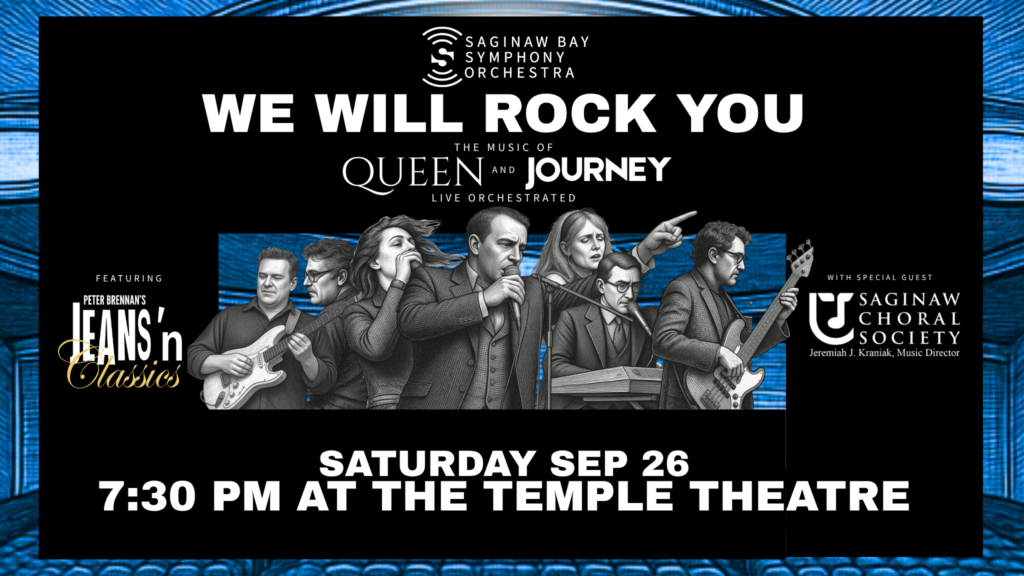
That’s exactly what we’re doing with We Will Rock You: The Music of Queen & Journey. The Saginaw Bay Symphony Orchestra will be joined by Jeans ’n Classics and the Saginaw Choral Society, bringing the rock band, featured vocalists, chorus, and orchestra together on one stage.
If Queen is already on your playlist, you don’t need to know anything about classical music before you walk through the doors. You already know the music. Come listen for the layers, the handoffs, the huge vocal moments, and all of those little details we’ve been talking about, only this time with dozens of musicians creating them right there in the room.
And maybe you’ll hear a song you’ve known for years a little differently.